Top Sights in Sigiriya
Sigiriya is known for two major rock formations, Sigiriya Rock Fortress and Pidurangala Rock.

Pidurangala Rock
Pidurangala Rock is a large granite formation located about one kilometre north of Sri Lanka’s Sigiriya fortress, and it has become a popular destination for visitors seeking wide views of the surrounding landscape and the nearby rock citadel.
The site has served as a Buddhist monastic retreat for more than 2,500 years and gained prominence in the fifth century when King Kasyapa moved monks there while constructing his palace at Sigiriya.
Visitors begin at the Pidurangala Raja Maha Viharaya, a white Buddhist temple at the base of the rock, before starting the climb.
The ascent follows a steep, forested path of uneven stone steps, passing a 12.5-metre reclining Buddha statue carved into a shallow cave along the route.
The final section requires scrambling over large granite boulders and narrow crevices, making the climb more physically demanding than the stairways at Sigiriya.
At the summit, visitors are rewarded with a sweeping view that places Sigiriya at the centre of the landscape, with the rock fortress rising prominently above the surrounding jungle.
The flat granite peak also provides a full 360-degree panorama across the central plains, making sunrise and sunset particularly popular times to visit.

Sigiriya Rock Fortress
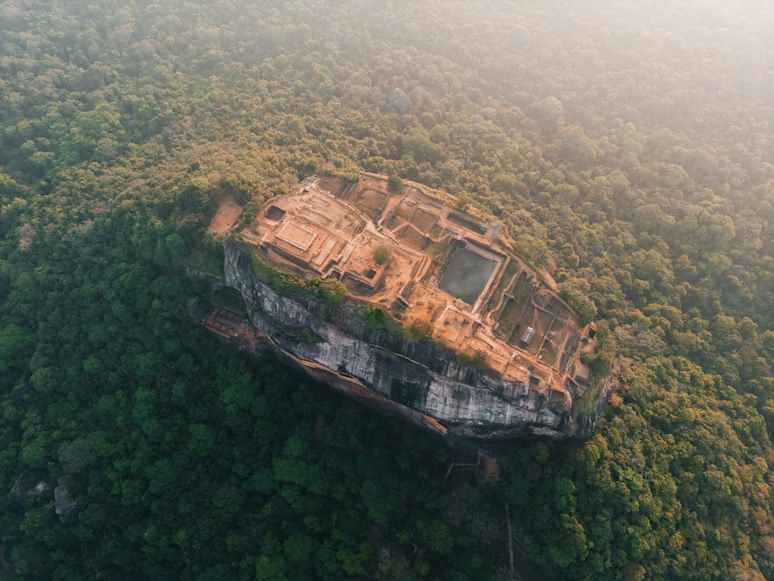
Sigiriya Rock Fortress is a fortified palace built on a granite outcrop nearly 200 metres above the surrounding plains, and it is widely regarded as a major example of early urban planning in South Asia.
The site was established as a royal capital in the late fifth century by King Kasyapa, who moved the seat of power from Anuradhapura after seizing the throne by killing his father.
Kasyapa chose the near-vertical rock to create a defensible stronghold against his rival brother, Moggallana, and he transformed the summit into a fortified palace complex.
Archaeological evidence shows the flat summit, covering about 1.6 hectares, once contained royal residences, audience halls, bathing pools and rock-cut cisterns designed to store rainwater.
Access to the upper fortress was originally through a monumental brick lion, from which Sigiriya takes its popular name, Lion Rock, and today only the enormous stone paws remain at the northern entrance.
At ground level, the surrounding city was laid out with remarkable precision, featuring symmetrical gardens, terraced landscapes and a complex hydraulic system.
These water gardens include ponds, canals and fountains that continue to function during the rainy season, demonstrating advanced engineering for the period.
Midway up the western face of the rock, a sheltered gallery contains the site’s renowned frescoes depicting female figures, often interpreted as celestial maidens.
Nearby, the Mirror Wall retains traces of its original polished surface and is covered with inscriptions left by visitors between the seventh and eleventh centuries, offering rare insight into early Sinhala language and poetry.
Following Kashyapa’s defeat and death in 495 CE, Sigiriya reverted to a Buddhist monastic site before gradually being abandoned.
UNESCO recognised Sigiriya as a World Heritage Site in 1982, describing it as one of the best-preserved examples of ancient urban planning in South Asia.

Royal Gardens of Sigiriya
The Royal Gardens of Sigiriya are a historic example of early urban landscape planning at the base of Sri Lanka’s iconic rock fortress, combining architecture, engineering and natural terrain.
Located beneath the fifth-century citadel, the gardens showcase advanced hydraulic engineering through a planned system of pools, fountains and waterways that remain partially functional today.
The garden complex is divided into three main zones—Water Gardens, Boulder Gardens and Terrace Gardens—each reflecting a different design approach from the site’s royal phase.
The Water Gardens extend inward from the western entrance and form the central visual axis, with symmetrical pools and ponds fed by underground terracotta pipes and seasonal fountains that still operate during heavy monsoon rains.
Beyond the Water Gardens, the Boulder Gardens are dominated by natural granite outcrops, where pathways, caves and platforms were built around the rocks, integrating earlier monastic spaces into the later palace complex.
Many of the boulders are believed to have been used by Buddhist monks before King Kashyapa I transformed the area into a fortified royal centre, with some later adapted for defensive use.
The Terrace Gardens rise gradually along the base of the rock, supported by stone retaining walls and connected by stairways, providing a controlled ascent for the royal court and views across the surrounding plains.
Sigiriya Rock And Archaeological Museum
Sigiriya Rock and Archaeological Museum is a visitor centre that explains the history and archaeology of the fifth-century Sigiriya citadel, a fortress and palace built on a granite rock outcrop above the surrounding plains.
Located near the main entrance to the Sigiriya Archaeological Park, the museum functions as the primary starting point for visitors before they climb the rock, providing context for what they will see on the site.
Opened in 2009, the museum draws on decades of excavation and academic research to show how Sigiriya evolved from an early settlement into a royal palace complex during the reign of King Kasyapa.
A central feature is a large-scale model of the entire site, allowing visitors to visualise the layout of the fortress, water gardens and the wider urban landscape that once surrounded the rock.
The galleries display artefacts recovered during excavations, including tools, pottery, sculptures, jewellery and decorative objects linked to everyday life and royal use.
A dedicated prehistoric section presents evidence of human activity in the area long before the citadel was built, showing that the site was occupied in earlier periods.
Other displays interpret key architectural and artistic features, such as the rock frescoes of female figures, the highly polished Mirror Wall and its inscriptions, and the advanced hydraulic systems that still function in the water gardens.