Top Sights in Jaffna
Jaffna is the capital of Sri Lanka’s Northern Province and is located at the northern tip of the island on the Jaffna Peninsula.

Casuarina Beach
Casuarina Beach is located on Karainagar Island, about 20 kilometres northwest of Jaffna city.
The beach is often regarded as one of the finest in Jaffna and is known for its calm and shallow waters, which make swimming and sea bathing safe.
It takes its name from the casuarina trees that border the shoreline.
Jaffna Fort
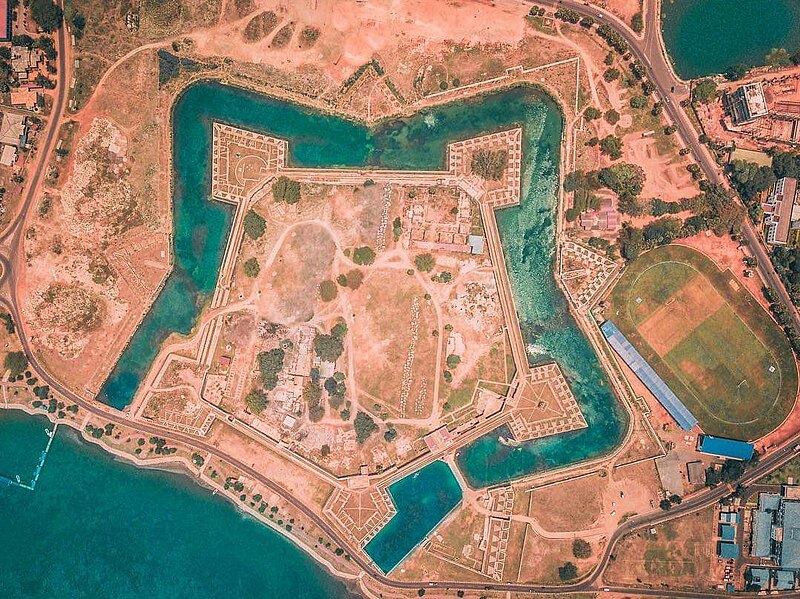
Jaffna Fort is the second-largest colonial fortification built by Europeans in Sri Lanka and stands on the edge of the Jaffna lagoon as a major historic landmark in the north.
The fort was first constructed by the Portuguese in 1618 after their conquest of the Jaffna Kingdom, taking the form of a square defensive structure.
It was named the Fortress of Our Lady of Miracles of Jafanapatão, a title linked to reports of miracles associated with a nearby church during the early Portuguese period.
Dutch forces captured the fort in 1658 and rebuilt it as a carefully planned pentagonal fortress, adding five bastions and a star-shaped moat that reflected advanced military engineering of the time.
British forces took control in 1795 following the Dutch surrender and used the fort mainly as a garrison and administrative centre.
Much of the Dutch-era design was preserved under British rule, allowing the fort’s distinctive layout and architectural character to survive largely intact.

Nallur Kandaswamy Temple
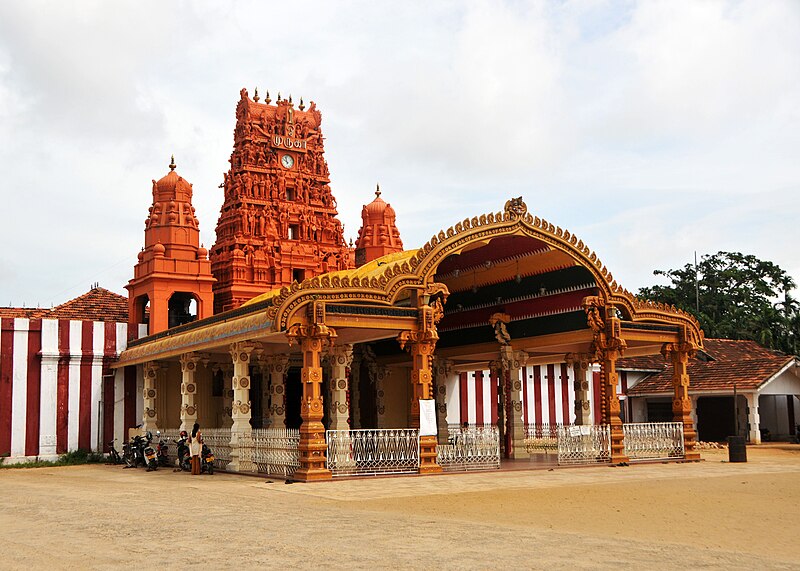
Nallur Kandaswamy Temple is a Hindu place of worship in Nallur, about three kilometres from central Jaffna, and is dedicated to Lord Murugan, a deity linked with war, victory and wisdom.
Historical sources and tradition trace the origins of the temple to the 10th century, a period when Jaffna developed as an important centre of Hindu worship in northern Sri Lanka.
The shrine has been rebuilt several times following destruction caused by political change and foreign rule, with a second structure expanded in the 13th century under the patronage of the Jaffna Kingdom.
A third version was constructed in the 15th century by Sapumal Kumaraya, also known as Chempaha Perumal, who governed Jaffna on behalf of the Kotte Kingdom.
Portuguese forces led by Filipe de Oliveira destroyed the temple in 1621 and reused its stone in the construction of Jaffna Fort.
The present temple was established during the Dutch period in either 1734 or 1749 by Ragunatha Maapaana Mudaliyar, restoring the site as a centre of Hindu worship.
The architecture follows South Indian Dravidian traditions combined with features resembling fortified structures, with four large Raja Gopurams covered in detailed sculptures of Hindu deities and mythological figures.
High enclosing walls surround a series of courtyards, halls and administrative buildings that together form a self-contained sacred complex.
At the centre is the main shrine area with several ceremonial halls, including the Vasantha Mandapam and the Shanmuga Sabhai, which is marked by a distinctive golden roof and dedicated to the six-faced form of Lord Murugan.
The temple is internationally known for the annual Nallur Mahotsavam, a 25-day festival usually held in August or September that attracts large crowds of devotees.
The main highlight is the Ther Thiruvila, or chariot festival, during which thousands of worshippers pull a large wooden chariot carrying the deity through the surrounding streets.

Chaddy Beach
Chaddy Beach, also known as Charty Beach or Chaddi Kadal, is a quiet coastal area on Velanai Island, about 15 kilometres west of Jaffna city, and is known for calm seas and limited tourist activity.
Facing the Palk Strait, the beach has shallow waters that are naturally protected from strong waves by surrounding land, making it suitable for family bathing and children’s swimming.
The shoreline is marked by pale golden sand and clear turquoise water, with palmyra palms, coconut trees and sparse vegetation that reflect the typical landscape of Sri Lanka’s northern coast.
Traditional fishing activity and everyday coastal life remain visible in the area, offering a glimpse into local Tamil culture and long-standing seaside practices.

Keerimalai Naguleswaram Temple
Keerimalai Naguleswaram Temple is an ancient Hindu shrine on the northern coast of the Jaffna peninsula near Kankesanthurai, overlooking the Indian Ocean and known as one of the region’s most important Shaivite sites.
Dedicated to Lord Shiva, the temple is recognised as one of the Pancha Ishwarams, a group of five coastal temples traditionally believed to hold spiritual importance for the protection of the island.
The temple is closely connected to the nearby Keerimalai Springs, a series of natural mineral water pools by the sea that have attracted pilgrims for centuries because of their reputed healing qualities.
Hindu tradition says the site takes its name from the sage Nagula Muni, who is believed to have been cured of a physical deformity after bathing in the springs and later founded a place of worship there.
Historical accounts state that the original temple structure was largely destroyed by Portuguese forces in 1621, leading priests to hide sacred icons in a nearby well to prevent damage.
After remaining in ruins for many years, the temple was restored in 1894 under the guidance of Hindu reformer Arumuka Navalar, re-establishing it as a centre of worship in northern Sri Lanka.

Kadurugoda Viharaya
Kadurugoda Viharaya, also known as Kantharodai, is a historic Buddhist archaeological site on the Jaffna Peninsula, noted for its distinctive cluster of small stupas.
Archaeological evidence links the site to the Anuradhapura era, indicating the presence of Buddhist activity in the northern region more than two thousand years ago.
About 20 miniature stupas remain visible today, although early archaeological records suggest that up to 60 structures once stood within the complex.
Excavations carried out in 1917 by historian Paul E. Pieris uncovered coins from the Roman Empire and several Indian dynasties, highlighting Kantharodai’s role in ancient trade and cultural exchange.
According to local tradition, the stupas are believed to commemorate 60 enlightened monks who are said to have died during a time of famine or conflict.

Dambakola Patuna
Dambakola Patuna, also known as the Port of Jambukola, is an ancient harbour on the northern coast of the Jaffna Peninsula that is closely linked to the early history of Buddhism in Sri Lanka.
The site is traditionally identified as the landing place of Theri Sangamitta in the 3rd century BC, when she arrived from India carrying a sapling of the sacred Jaya Sri Maha Bodhi tree.
Historical chronicles state that King Devanampiyatissa received the delegation by wading into the sea and later ordered the construction of the Jambukola Viharaya to mark the occasion.
The arrival is regarded as a defining moment in the island’s religious history, occurring about a year after Buddhism was introduced by Mahinda Thero.
Over time, the harbour declined in importance and the original temple and port structures gradually fell into ruin.
A modern religious complex now stands at the site, centred on the Sri Sangamitta Viharaya, which features a white stupa and a Bodhi tree.
The Bodhi sapling was planted in 1998 by the Sri Lanka Navy, which continues to oversee and maintain the temple grounds.