
Top Sights in Anuradhapura
Anuradhapura is the first capital of Sri Lanka, located in the north-central part of the island, and is a UNESCO World Heritage Site known for its ancient ruins, Buddhist stupas, and advanced irrigation engineering.

Samadhi Buddha Statue
Samadhi Buddha Statue is a 4th-century granite Buddhist sculpture located in the Mahamewna Gardens in Anuradhapura.
The statue shows the Buddha in the Dhyana Mudra, a hand position that signifies deep meditation, and it stands about 2.2 metres tall.
Carved from a single block of stone, the statue is famous for its calm and balanced expression, which appears to change subtly when viewed from different angles.
It was originally part of a set of four statues placed around a sacred Bodhi tree, but it is the only one that has survived mostly intact.

Ruwanweli Maha Seya
Ruwanweli Maha Seya is a large stupa in Anuradhapura, built in the 2nd century BCE by King Dutugemunu.
It is highly revered for enshrining a significant portion of the Buddha’s relics, traditionally measured as a full drona.
The stupa stands about 103 metres tall with a white, dome-shaped “bubble” and has a circumference of roughly 290 metres.
A paved courtyard surrounds the base, bordered by a wall featuring nearly 1,900 sculpted elephants that symbolically support the monument.
King Dutugemunu died before the stupa was completed, and his brother King Saddhatissa finished the construction and plastering.
The site is also linked to Buddhist tradition, including sanctification by four Buddhas of the current eon and a prophecy by Arahant Mahinda.

Abhayagiriya Stupa
Abhayagiriya Stupa is a major Buddhist monument located in the northern sector of Anuradhapura, built in the 1st century BCE by King Valagamba after he regained his throne from foreign invaders.
The name combines the king’s title, Abhaya, with that of a Jain monk, Giri, in reference to a vow made during his exile.
Originally one of the tallest structures of the ancient world, the stupa is believed to have reached around 115 metres, but today it stands at approximately 75 metres, with a square pedestal, or Hatharas Kotuwa, remaining from the original construction.
The surrounding Abhayagiri Vihāra became a major monastic complex, accommodating more than 5,000 monks and serving as a centre for Mahayana and Vajrayana Buddhist practice.
Excavations at the site have revealed artifacts including coins, jewellery, and the remains of a 20-foot jade Buddha statue described by the Chinese traveler Fa-Hsien.

Jaya Sri Maha Bodhi
Jaya Sri Maha Bodhi is a sacred fig tree located in the Mahamewna Gardens of Anuradhapura, planted in 288 BCE and widely recognized as the oldest living human-planted tree with a documented planting date.
The tree grew from a sapling brought from the original Bodhi tree in Bodh Gaya, India, under which Gautama Buddha attained enlightenment, and Princess Sangamitta, daughter of Emperor Ashoka, brought the sapling to Sri Lanka during the reign of King Devanampiya Tissa.
The tree stands on a raised terrace approximately 6.5 metres above the ground and is protected by a golden railing.
Successive Sri Lankan monarchs have maintained the site for over 2,300 years, adding walls, water canals, and other protective measures to safeguard it from environmental and animal threats.

Jetavanaramaya Stupa
Jetavanaramaya Stupa is a large brick monument located within the Jetavana monastery ruins in Anuradhapura.
Construction began in the 3rd century CE under King Mahasena and was completed by his son Maghavanna I, with the stupa intended to house a relic believed to be part of the Buddha’s belt.
Originally standing at about 122 metres, it was the tallest stupa of its time and the third tallest structure worldwide, but restoration in the 12th century under King Parakramabahu I reduced its height to approximately 71 metres.
It remains one of the largest brick structures ever built, using an estimated 93 million bricks.
The stupa was erected on the former Nandana Pleasure Garden, a site associated with Arahant Mahinda’s first discourse in Sri Lanka.
The complex includes a monk’s refectory, an image house, and a library that once contained significant Mahayana texts, and its construction followed the destruction of the Mahavihara, reflecting historical tensions between Theravada and Mahayana traditions within the Buddhist monastic community.

Thuparama
Thuparama Dagoba is the first Buddhist stupa built in Sri Lanka after the introduction of the religion, located in the sacred city of Anuradhapura.
It was constructed in the 3rd century BCE by King Devanampiya Tissa under the guidance of Mahinda Thera.
The stupa enshrines the right collarbone relic of the Buddha, making it a major pilgrimage site.
Ancient chronicles describe the relic performing miracles upon its arrival, including rising into the air and emitting light and water before settling in the chamber.
Thuparama originally had a “heap-of-paddy” shape and was housed within a circular relic house, or vatadage, and while the wooden roof no longer survives, 41 stone pillars remain, evidence of the original structure, which is thought to have comprised 176 pillars arranged in four concentric circles.
The stupa now stands approximately 19 metres high with a bell-shaped dome, surrounded by the tranquil Mahamewna Gardens.
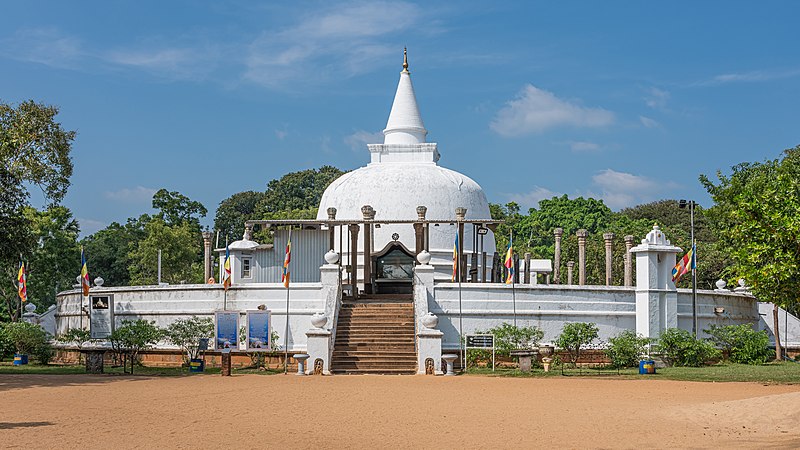
Lankaramaya Dagoba
Lankaramaya Dagoba is an ancient stupa located within the Abhayagiriya monastery complex in Anuradhapura.
It was built in the 1st century BCE by King Valagamba (Vattagamani Abhaya) and stands on a circular platform about three metres high.
The stupa was originally enclosed by a vatadage, a roofed structure supported by 88 stone pillars arranged in three concentric circles.
The site is associated with the location where King Valagamba hid while fleeing from invaders and is traditionally believed to enshrine a relic of the Buddha’s waist belt.
Local tradition also holds that the stupa contains jewellery belonging to Queen Soma Devi, who is said to have sacrificed herself to help the king escape.

Avukana Buddha Statue
Avukana Buddha Statue is a 5th-century rock sculpture located near Kekirawa in Sri Lanka’s Anuradhapura district.
Carved from a single granite outcrop, the statue stands over 14 metres tall including its lotus pedestal and is regarded as one of the finest examples of standing Buddha sculptures in the country.
Tradition links the statue to King Dhatusena, who built the nearby Kala Wewa reservoir, and local legend says it was created in a contest between a master sculptor and his pupil, with the master finishing the Avukana figure first.
The statue depicts the Buddha in the Asisa mudra, with the right hand raised sideways toward the shoulder and the left hand gathering the robe, and it faces east.
The carving is noted for its architectural precision, and it is said that a drop of water falling from the nose would land in a small depression carved between the toes.

Rathna Prasadaya
Rathna Prasadaya, also known as the Gem Palace, is an Uposatha hall within the Abhayagiriya monastery in Anuradhapura.
It was first built in the 2nd century CE by King Kanittha Tissa and was later expanded into a multi-storey structure by Kings Mihindu II and Mihindu IV.
The site is renowned for its guardstone, or muragala, which depicts the Cobra King holding a pot of abundance beneath a seven-hooded cobra, with a small dwarf figure at his feet.
Ruins at the site show rows of large monolithic pillars, some about 22 feet tall, indicating the building once had several upper storeys and served as a major centre for monastic rituals.
.jpg/800px-Lovamahapaya_Anuradhapura_2017-10-15_(2).jpg)
Lovamahapaya
Lovamahapaya, or the Brazen Palace, is a historic monastic complex in Anuradhapura, located between the Ruwanweliseya Stupa and the Jaya Sri Maha Bodhi.
It was originally constructed in the 2nd century BCE by King Dutugemunu as a nine-storey residence for monks of the Maha Vihara monastery.
The palace earned its name from the bronze tiles that once covered its roof, reportedly shining brightly enough to be seen from miles away.
Ancient chronicles describe the structure as containing around 1,000 rooms, with floors arranged according to spiritual rank, and decorated with precious stones, silver, and ivory.
Lovamahapaya was damaged and rebuilt several times over the centuries, with a major fire during the reign of King Saddhathissa leading to reconstruction, and later rulers carrying out further restorations and alterations.
Today, 1,600 granite pillars arranged in a 40 by 40 grid mark the site, remnants of a 12th-century restoration by King Parakramabahu I, and a small modern building in the centre serves as the Uposatha house for the resident monastic community.