Ancient City of Polonnaruwa
Polonnaruwa, located in Sri Lanka’s North Central Province, is an ancient city that served as the island’s second capital from the 11th to the 13th century.

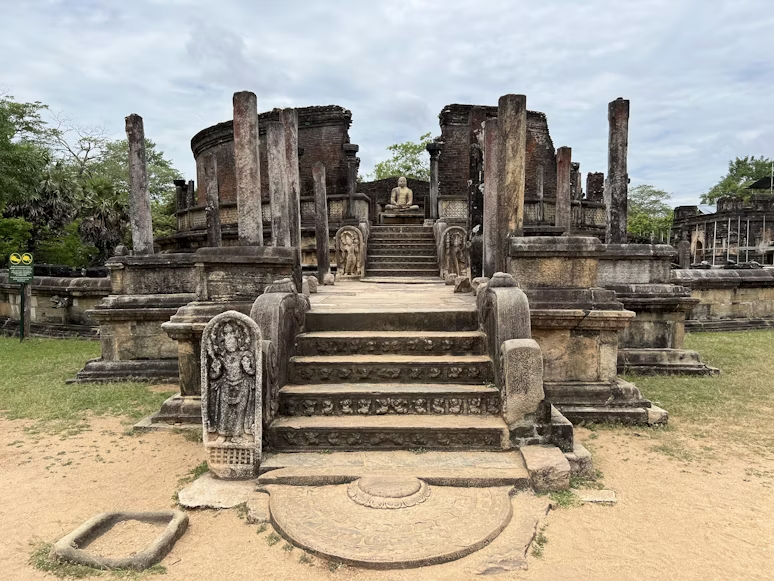
Polonnaruwa Vatadage
The Polonnaruwa Vatadage is a circular relic house dating back to the 12th century and is considered one of the best-preserved vatadage structures in Sri Lanka.
Location: The vatadage is located within the Dalada Maluva sacred quadrangle in the ancient city of Polonnaruwa.
Construction: The vatadage is generally attributed to King Parakramabahu I or King Nissanka Malla, who is believed to have built it to house the Sacred Tooth Relic of the Buddha or the alms bowl used by the Buddha.
The Lower Platform: The lower platform measures about 120 feet in width and includes a single gateway facing north that leads toward the central shrine. Its outer edge is decorated with carved stone, including lions and other symbolic designs.
The Upper Platform: The upper platform, about 80 feet wide, is reached by four entrances aligned with the cardinal directions. It once held three concentric rows of stone pillars that likely supported a wooden roof.
The platform, enclosed by a brick wall, contains the central stupa, with four Buddha statues in the meditation posture seated around it, each facing the four cardinal points.
Sandakada Pahana (Moonstones): The moonstone at the northern entrance is considered the finest example from the Polonnaruwa period. It reflects changes in artistic tradition, including the removal of certain animals from the decorative band due to Hindu influence at the time.
Muragala (Guardstones): The stairways leading to the upper platform are flanked by guardstones carved with protective figures.
Korawakgala (Balustrades): The balustrades beside the stairways feature carvings of mythical creatures, adding to the decorative elements of the structure.

Statue of King Parakramabahu
The Statue of King Parakramabahu is a 12th-century rock sculpture carved into a granite boulder near the Parakrama Samudra reservoir.
Location: The statue is situated close to the Parakrama Samudra reservoir and the Pothgul Viharaya monastic complex.
Construction: Standing about 3.5 metres tall, The identity of the constructor of the Statue of King Parakramabahu in Polonnaruwa remains unknown and debated. Most historians and locals traditionally attribute the statue to the reign of King Parakramabahu the Great himself.
The sculpture: The sculpture is widely identified as King Parakramabahu I, the ruler associated with the peak of political power in medieval Polonnaruwa. The figure depicts an elderly man with a calm, dignified expression, a long beard, and a moustache, holding an object in both hands often interpreted as a palm leaf manuscript (ola leaf) or a yoke.
.jpg/800px-Potgul_Vehera_2017-10-17_(8).jpg)
Pothgul Viharaya
Pothgul Viharaya is a monastic library complex dating back to the 12th century. It is widely regarded as the oldest known library found in Sri Lanka, and its name translates as “Library Monastery.”
Location: Located near the Parakrama Samudra reservoir in the ancient city of Polonnaruwa.
Construction: The complex is traditionally attributed to King Parakramabahu I, and historical tradition holds that it was later restored or supported under the patronage of Queen Chandrawathi.
Pothgul Viharaya: Pothgul Viharaya is closely linked to royal learning and religious instruction, with tradition stating that the king sat within its central chamber to listen to monks recite Jataka stories, which recount the previous lives of the Buddha.
Architecture: The site is noted for its Gedige-style construction, using thick brick walls and a hollow interior rather than timber supports. Archaeological evidence suggests the structure once had a corbelled or vaulted roof that has since collapsed. The monastery is arranged on four square terraces built on ascending levels, creating a stepped layout.
Central building: At the centre of the uppermost terrace stands a circular brick structure known as the Mandala Mandira, believed to have served as the main library for storing palm-leaf manuscripts.
Stupas on the terrace: Four small solid brick stupas are positioned at the corners of the central terrace, creating a balanced and symmetrical plan.
Supporting structures: The surrounding ruins include residential and administrative buildings that would have supported the monks associated with the complex.

Polonnaruwa Gal Viharaya
Gal Viharaya, originally called Uttararama or the Northern Monastery, is a 12th-century rock temple known for four monumental Buddha statues carved into a single granite rock face.
Location: It is located in the northern part of the ancient city of Polonnaruwa.
Construction: The site was commissioned by King Parakramabahu I as part of a monastic complex.
The four Buddha statues: Four Buddha statues at Gal Vihara are carved directly into a single granite rock face. They vary in size, with the largest over 46 feet long and the smallest just over 4 feet tall.
Seated Buddha Statue: The large seated Buddha is 15 feet tall and is in a meditative posture.
Smaller Seated Buddha: The smaller statue is 4 feet tall and carved inside a cave called the Vidyadhara Guha.
Standing Buddha Statue: The standing Buddha is 22 feet tall. Its arms are folded across the chest and it has a sorrowful expression. Some scholars have debated whether this statue represents the Buddha or the monk Ananda.
Reclining Buddha: The reclining Buddha is the largest statue at Gal Vihara. It is 46 feet long and depicts the Buddha’s parinirvana. The Buddha lies on his right side with the right arm supporting his head on a bolster and the left arm resting along the body. The left foot is slightly withdrawn to indicate that the Buddha has attained parinirvana.

Atadageya
Atadage is an early Buddhist relic house in the ancient city of Polonnaruwa and is the oldest surviving structure within the Dalada Maluva sacred quadrangle.
Construction: The shrine was established in the 11th century by King Vijayabahu I after defeating the Chola rulers and restoring Buddhist worship on the island. Its construction marked Polonnaruwa’s emergence as the new royal and religious capital of Sri Lanka.
Name of the shrine: The building is traditionally known as the House of Eight Relics, a name linked by scholars to the enshrinement of several important Buddhist relics alongside the Sacred Tooth Relic.
Structure: Archaeological evidence suggests Atadage was originally a two-storey structure, with a timber-built upper floor that housed the Tooth Relic and a stone-built ground floor used as an image house. Only the lower level survives today, defined by the remains of 54 stone pillars that once supported the wooden upper chamber. Sections of a stone staircase leading to the relic floor are still visible among the ruins.
Standing Buddha statue: Inside the inner chamber, a single standing Buddha statue remains at the rear, while two other images that once stood there have been lost over time.
Entrance: The entrance is marked by a carved moonstone and guardstones, which historians believe were transported from the former capital of Anuradhapura. These features reflect continuity in royal Buddhist architecture as political power shifted between Sri Lanka’s ancient capitals.

Nissanka Latha Mandapaya
Nissanka Latha Mandapaya is a 12th-century stone pavilion in the ancient city of Polonnaruwa, built by King Nissanka Malla as a ceremonial space for listening to the chanting of Buddhist scriptures.
Location: The structure stands within the Dalada Maluva sacred quadrangle, close to the precinct associated with the Sacred Tooth Relic.
Construction: The pavilion is regarded as one of the most distinctive architectural monuments of the Polonnaruwa period because its stone design differs markedly from the conventional forms used in royal and religious buildings of the era. It rests on a raised stone platform enclosed by a carved stone railing designed to imitate a wooden fence, a feature commonly associated with early Buddhist architecture. Archaeological evidence suggests the pavilion was originally covered by a wooden roof, which has not survived.
Central stupa: At the centre of the platform is a small stone stupa, believed to have served as a pedestal for a relic casket during ritual observances.
Lotus pillars: The most notable elements are its eight granite pillars, each carved to resemble the curved stem of a lotus plant, bending at three points and rising to about eight feet in height. Each pillar is topped with a capital shaped like a closed lotus bud, reinforcing the floral theme that dominates the structure’s design.

Lankatilaka Image House
Lankatilaka Image House is a 12th-century Buddhist shrine in the ancient city of Polonnaruwa, built by King Parakramabahu I and recognised as the largest Gedige, or vaulted-roof image house, in Sri Lanka.
Location: The structure is part of the Alahana Pirivena monastic complex and is located just south of the Kiri Vehera stupa.
Construction: Built entirely of brick, the building follows the Gedige architectural tradition, using thick masonry walls and vaulted roofs instead of timber frameworks. Although the roof has collapsed, the remaining walls rise to about 17 metres, indicating the original height and scale of the monument. Historical sources suggest the building once rose to five storeys.
Central Buddha statue: The central feature of the shrine is a colossal standing Buddha statue that originally stood about 41 feet tall, made from specially shaped clay bricks and attached to the rear wall of the image house. The statue has lost its head and arms but remains a dominant element of the interior.
Entrance: The main entrance is flanked by two massive brick pylons, with the tallest surviving pillar reaching approximately 58 feet. Stone elements such as a moonstone, guard stones, and balustrades mark the threshold, reflecting the ceremonial design conventions of the period.
Upper levels: Inside, narrow staircases lead to the upper levels, arranged so that visitors ascend sideways to avoid turning their back on the Buddha image.

Medirigiriya Vatadage
Medirigiriya Vatadage is an ancient circular relic house dating back to the 7th century, considered one of the most beautiful and well-preserved examples of a Vatadage (circular relic house) in the country.
Location: The monument is located in the Medirigiriya area of the Polonnaruwa District in the North Central Province of Sri Lanka. It is situated about 30 kilometers north of the main Polonnaruwa ancient city.
Construction: Built on a natural rock outcrop, historical records suggest that the initial stupa at this site was constructed during the reign of King Kanittha Tissa in the 2nd century AD, while the circular structure is attributed to King Aggabodhi IV in the 7th century AD.
Structure: The shrine is centred on a small stupa and surrounded by three concentric circles of stone pillars. Sixty-eight columns originally supported a wooden domed roof that protected the relic chamber.
The upper platform: This is the heart of the monument, approximately 27 meters (88 feet) in diameter, enclosed by a beautifully carved stone wall known as a Vedika pavada. At the center sits the small stupa, surrounded by four large seated Buddha statues facing the cardinal directions.
The Lower Platform: The lower platform forms the base of the monument, connecting the natural rock ground to the sacred upper area. Access to the upper platform is from the northern side via a stone staircase. Surrounding the elevated structure is a wide, sand-covered terrace (Valuka Maluwa), where pilgrims could gather before ascending to the main shrine.
Buddha statues: Four seated Buddha statues carved from limestone are positioned around the stupa, each facing one of the cardinal directions.

Hatadageya
Hatadageya is a 12th-century relic house built to house the Sacred Tooth Relic of the Buddha.
Location: house located within the Dalada Maluva sacred quadrangle of the ancient city of Polonnaruwa.
Construction: The structure was commissioned by King Nissanka Malla and constructed during the 12th century.
Name: The name Hatadage is commonly understood as “House of Sixty,” referring either to sixty relics once kept inside or to a tradition that the structure was completed within sixty hours.
Structure: Hatadageya was built as a two-storey structure, with a stone ground floor and an upper level constructed from wood. Although the wooden upper storey and roof have not survived, the lower section of the building remains largely intact.
Buddha statues: The inner sanctum contains three large standing Buddha statues carved from limestone and placed against the rear wall.
Carvings: The entrance carries detailed stone carvings, including figures of musicians and dancers, which are considered more refined than those at the earlier Atadage. The entrance features a beautifully carved doorway and a moonstone that reflects the high artistic standards of the Polonnaruwa period.
Inscriptions: Large stone inscriptions carved near the entrance provide rare primary evidence of royal involvement during the reign of King Nissanka Malla.

Kiri Vehera
Kiri Vehera is a white Buddhist stupa dating back to the 12th century and noted for the preservation of its original lime plaster.
Location: situated within the Alahana Pirivena monastery complex in the ancient city of Polonnaruwa.
Construction: The monument was commissioned by Queen Subhadra, a consort of King Parakramabahu I.
Name of the Stupa: Its name, Milk Stupa or Kiri Vehera, refers to its original white lime plaster, and the structure also retains its original shape.
Dimensions: The stupa stands on a raised square platform and reaches a height of about 29 metres, or roughly 80 feet. The structure is built of brick and completely covered with lime plaster.