
Top Sights in Galle
Galle is a fortified port city on Sri Lanka’s southwestern coast, best known for Galle Fort, a UNESCO World Heritage Site that reflects centuries of European colonial rule and maritime trade.

Galle Dutch Fort
Galle Dutch Fort is the largest surviving European-built fortress in Asia and a UNESCO World Heritage site on Sri Lanka’s southern coast.
The fort stands on a rocky headland and is surrounded on three sides by the Indian Ocean, giving it strong natural defence and clear sea views.
It was first built by the Portuguese in 1588 to protect maritime trade routes linking Asia and Europe.
Dutch forces captured the fort in 1640 and expanded it with stone ramparts, bastions, warehouses, and administrative buildings that defined its present form.
British control began in 1796, when the fort was adapted for civilian use and commercial activity rather than military defence.
The fort is protected by 14 bastions placed at key points along the walls. Notable examples include Sun, Moon, Star, Neptune, Triton, and Point Utrecht bastions.
Inside the walls, the streets follow a planned grid layout that connects historic buildings, homes, and shops.
Rampart Street links several bastions along the sea wall, while Church Street is home to the Groote Kerk and All Saints’ Church.
Hospital Street contains the former Dutch hospital, now a shopping precinct, with views of the ocean from Aurora Bastion.
Leyn Baan Street and Queens Street feature mosques, museums, and large colonial-era mansions that reflect the area’s diverse past.
Today, Galle Fort remains a living community where restored villas house galleries, cafés, shops, and private residences.
Portuguese, Dutch, and British architectural styles blend with modern life, making the fort both a historic monument and an active urban space.

Galle Fort Clock Tower
The Galle Fort Clock Tower is a four-storey stone monument standing on Moon Bastion inside Galle Fort in southern Sri Lanka.
Built in 1883 during British rule, the tower rises about 25 metres and was erected as a memorial to Dr Peter Daniel Anthonisz, a well-known local surgeon.
The project was funded through public donations, reflecting the regard in which Dr Anthonisz was held by the local community.
The clock mechanism was presented by Mudaliyar Samson de Abrew Rajapakse, a former patient of Dr Anthonisz and a prominent figure of the period.
Architecturally, the tower blends Victorian design elements with the heavy stone construction typical of the earlier Dutch fortifications.
Located near the main entrance to the fort, the tower overlooks the Galle International Cricket Stadium and the Indian Ocean and remains a key landmark within the UNESCO World Heritage site.

Galle Lighthouse
The Galle Lighthouse also known as Pointe de Galle Light is the oldest lighthouse in Sri Lanka. it is located on Point Utrecht Bastion within the historic walls of Galle Fort.
First established by the British in 1848, the present white tower which was Rising 26.5 metres was rebuilt in 1939 after the original iron lighthouse was destroyed by a fire.

National Maritime Museum
The National Maritime Museum in Galle is a public museum inside the historic Galle Fort that documents Sri Lanka’s long relationship with the sea.
The museum stands on Queen’s Street in a large Dutch warehouse built in 1671 and opened to visitors in May 1992 after restoration.
Its collections include objects recovered from shipwrecks such as cannons, pottery, coins, and personal items of sailors, alongside models of traditional boats, early maps, and material linked to the Dutch East India Company.
Several galleries focus on marine life and coastal activity, displaying corals, shells, fishing equipment, a 13.5-metre whale skeleton, and objects recovered after the 2004 tsunami.
The former warehouse reflects colonial industrial design and once supported maritime trade, while today it presents the history of seafaring, shipwrecks, and marine environments along Sri Lanka’s southern coast.
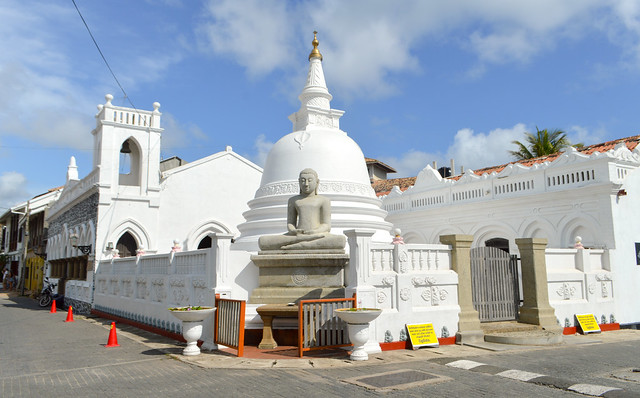
Sri Sudharmalaya Buddhist Temple
Sri Sudharmalaya Buddhist Temple is the only Buddhist place of worship located on Rampart Street within the historic Galle Fort.
Founded in 1889, the temple serves the Buddhist community inside the UNESCO-listed fort, where most religious buildings reflect Christian or Islamic traditions.
The structure blends European and traditional Buddhist design, showing the mixed cultural history of the fort.
Its white façade features lobed arches and a distinctive belfry, while the main hall opens onto a small interior courtyard with surrounding shrines.
Inside, a large reclining Buddha statue forms the centre of worship, accompanied by wall murals illustrating key events from the Buddha’s life.
The temple grounds also include a small bell-shaped stupa used for devotion.
A modest collection of maritime artefacts and religious statues is displayed on the site, linking Buddhist practice with Galle’s long coastal and trading heritage.
Today, Sri Sudharmalaya remains an active religious centre and a rare symbol of Buddhist presence within the colonial streets of Galle Fort.

Galle National Museum
The Galle National Museum is a cultural history museum located inside Galle Fort, operating from the oldest surviving Dutch building in the fort, which was built in 1656 and later adapted for public use.
The structure was first used as a commissariat store for the Dutch garrison, then served as a billiards room during the colonial period, before being converted into a museum in 1986 as part of efforts to preserve the fort’s historical buildings.
The museum contains three galleries that present the cultural and historical heritage of southern Sri Lanka through everyday objects and trade materials.
The first gallery focuses on traditional cottage industries of the region, displaying items such as turtle shell jewellery, Beeralu lace, and carved wooden masks that reflect local skills passed down through generations.
The second gallery presents objects from the Dutch colonial period, including weapons, furniture, and household items that show how colonial officials lived and governed within the fort.
The third gallery examines Sri Lanka’s historical trade links with China, featuring porcelain associated with the Dutch East India Company, coins, and navigational instruments linked to maritime commerce.
Situated on Church Street within the fort, the Galle National Museum offers visitors an overview of colonial history, local craftsmanship, and overseas trade, contributing to the preservation and study of the region’s past.

Groote Kerk (Dutch Reformed Church)
The Groote Kerk, also known as the Great Church, is an 18th-century Dutch Reformed church inside Galle Fort that remains one of the oldest Protestant churches in Sri Lanka still in continuous use.
Completed in 1755 during the Dutch period, the church stands on an earlier site and was funded by the Dutch Commandeur of Galle, Casparus de Jong, and his wife as a thanksgiving offering after the birth of their daughter.
The building was designed in a restrained Doric style, reflecting Dutch colonial church architecture adapted to local conditions.
Inside, the church is noted for a floor laid with engraved gravestones, a rare hexagonal pulpit carved from calamander wood, a pipe organ installed in 1760, and wall plaques that record the names of Dutch officials and settlers associated with Galle.

Old Dutch Hospital - Galle
The Old Dutch Hospital is a 17th-century colonial building inside Galle Fort that has been restored as a major dining and leisure precinct open to the public.
Built by the Dutch to treat officers and company workers, the former hospital now houses restaurants, cafés and boutique shops set around open courtyards and shaded verandahs.
The structure was designed for the tropical climate, with thick cabok stone walls, timber floors and high ceilings to improve airflow, while the upper level provides wide views of the Indian Ocean and the fort ramparts.
Across its long history the building has functioned as a Dutch and later British medical facility, a military barracks and eventually Galle Town Hall before its modern restoration.