Top Sights in Trincomalee
Trincomalee is an ancient port city on Sri Lanka’s northeastern coast, known for its deep-water harbour, scenic beaches, and historic temples.

Nilaveli Beach
Nilaveli Beach is a coastal area about 16 kilometres north of Trincomalee, known for its long white sand shoreline and calm turquoise waters along Sri Lanka’s eastern coast.
The beach attracts visitors looking for relaxation and family-friendly recreation, with conditions that are generally calm and suitable for all ages.
The shoreline slopes gently into the Indian Ocean, creating shallow and clear waters that are ideal for swimming and bathing.
Its wide sandy stretch supports activities such as sunbathing, walking, and casual beach games without heavy crowding.
Nilaveli’s sea conditions are considered relatively safe for families, while options such as snorkelling, jet skiing, and windsurfing appeal to more active visitors.
Snorkelling at Nilaveli and nearby Pigeon Island National Park offers sightings of tropical fish, sea turtles, and young reef sharks.
Boats can be hired for a short 10 to 15 minute journey to Pigeon Island, which is known for its coral reefs and marine biodiversity.
Seasonal boat tours operating mainly between March and October also depart from Nilaveli, giving visitors chances to see blue whales, sperm whales, and spinner dolphins further offshore.

Pigeon Island Marine National Park
Pigeon Island Marine National Park is a protected marine area located about one kilometre off the coast of Nilaveli near Trincomalee on Sri Lanka’s northeast shore.
The park was designated as a sanctuary in 1963 and is widely known for its coral reefs, rich marine life, and open ocean scenery.
Covering about 471.4 hectares, the protected area consists of two small landmasses known as Large Pigeon Island and Small Pigeon Island, surrounded by rocky islets.
Large Pigeon Island is edged by coral reefs that support species such as blacktip reef sharks, hawksbill turtles, green turtles, and olive ridley turtles at different stages of life.
The shallow reefs around the islands make the park a popular location for snorkelling and diving due to clear water and easy access to marine habitats.
Visitors can also walk across the rocky island surface to reach elevated points that offer wide views of the Indian Ocean.
The island cliffs act as nesting and breeding areas for rock pigeons, which has made the site of interest to birdwatchers.
Access to Pigeon Island Marine National Park is usually by a 15 to 20 minute boat journey from Nilaveli Beach, which serves as the main entry point for visitors.

Fort Frederick
Fort Frederick is a colonial fortification located on Swami Rock peninsula in Trincomalee that overlooks Gokarna Bay.
It was built by the Portuguese in 1624 and later occupied and modified by the Dutch and the British.
The fort was constructed in part using stone taken from the Koneswaram Temple, which the Portuguese destroyed in 1622.
Inside the fort, visitors can find ramparts, stone gateways, cannons, barracks, and administrative buildings that reflect Portuguese, Dutch, and British architecture.
The rebuilt Koneswaram Temple now stands beside the fort at the seaward edge of Swami Rock.

Koneswaram Temple
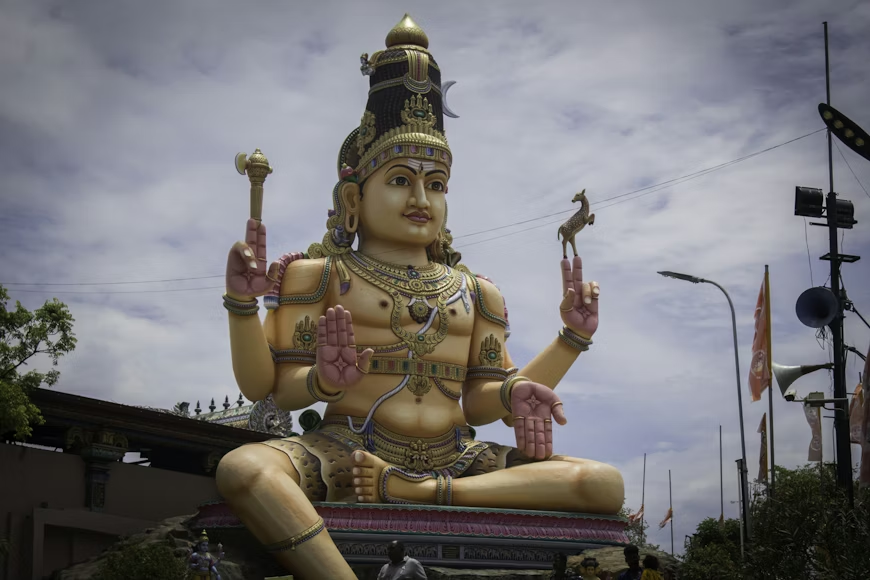
Koneswaram Temple is an ancient Hindu temple in Trincomalee located on the summit of Swami Rock overlooking Gokarna Bay and the Indian Ocean.
The temple serves as a primary site of worship for Lord Shiva and is recognized as one of the five ancient Pancha Ishwarams on the island.
The current structure was rebuilt in the 18th century and follows Dravidian architecture with an entrance tower covered in carved images of gods and mythological figures.
Portuguese colonial forces destroyed the original "Temple of a Thousand Pillars" in 1622 and used the debris to construct the nearby Fort Frederick.
The main shrine is dedicated to Shiva as Konesar while a golden statue of King Ravana reflects local stories linking him to the site and his devotion to Shiva.
Archaeological records and religious texts suggest that the original foundations of the temple date back to at least 300 BCE.
Rebuilding in the 18th century restored the temple’s religious role, maintaining its status as a significant cultural landmark in eastern Sri Lanka.

Trincomalee Harbour
Trincomalee Harbour is one of the largest natural deep-water harbours in the world, positioned inside Trincomalee Bay on the eastern coast of Sri Lanka.
The harbour lies to the north of Trincomalee Bay, which is part of a group of three bays that also includes Kodiyar Bay to the south and Tambalagam Bay to the west.
The basin holds about 1,630 hectares of water, with depths inside the harbour mostly above 20 metres and ranging from about 11 metres to more than 30 metres.
The combined water and land area is estimated to be about ten times larger than that of the Port of Colombo.
The entrance channel provides a minimum depth of about 22 metres, while parts of the outer bay fall to depths of more than 1,000 metres.
The harbour has been in continuous use since at least the 4th century BCE and later drew the strategic interest of colonial powers including the Portuguese, Dutch, French, and British.
Its military importance peaked during the Second World War, when it functioned as a major base for the Royal Navy’s Eastern Fleet and supported naval operations across the Indian Ocean.
The surrounding area contains several notable historical and cultural sites, including Fort Frederick, the ancient Koneswaram Temple, and the coastal cliff formation known as Lover’s Leap.

Velgam Vehera
Velgam Vehera is an ancient Buddhist temple located in Kanniya near Trincomalee, Sri Lanka, and it dates back to the 3rd century BCE during the reign of King Devanampiyatissa.
The site is known for its stone inscriptions written in Tamil, which record donations made by Sinhalese Buddhists, Tamil Buddhists, and Hindus, indicating the temple’s historical role as a cross-cultural religious centre.
Archaeological remains at Velgam Vehera include ancient ruins, an Image House that contains a well-preserved stone Buddha statue, and a brick stupa decorated with terracotta reliefs showing dancers and drummers.
The temple grounds also feature a sacred Bodhi tree that was grown from a sapling taken from the Sri Maha Bodhi in Anuradhapura, a significant symbol of Buddhist heritage.

Uppuveli Beach
Uppuveli Beach is a long coastline located northwest of Trincomalee town, suitable for swimming, sunbathing, relaxation and watersports.
Whale and dolphin watching tours operate from the shoreline between March and September when sea conditions are generally calm.
The beach is also used for snorkelling, diving, and walking, and is a popular spot to watch the sunrise or relax along the shore.
Uppuveli serves as a main departure point for boat trips to Pigeon Island National Park, a protected marine area off the Trincomalee coast.

Trincomalee War Cemetery
The Trincomalee War Cemetery, also known as the British War Cemetery, is dedicated to Commonwealth servicemen who died in Sri Lanka during World War II.
Established in the late 1940s, it is located along the Trincomalee–Nilaveli Road, six kilometres north of Trincomalee town, and is one of six Commonwealth war cemeteries in the country.
The cemetery provides a quiet space for visitors to pay respects and reflect on the sacrifices of Allied forces.
It contains over 300 graves, primarily of British servicemen, alongside soldiers from India, Canada, New Zealand, East Africa, and other Allied nations.
Many interred died during Japanese air raids on Trincomalee in April 1942, when the port served as a strategic Royal Navy and Allied base.
Each grave is marked with a white headstone inscribed with the soldier’s name, rank, regiment, and emblem.

Marble Beach
Marble Beach is a coastal area near Kinniya in Trincomalee, known for its soft white sand and calm turquoise waters.
The beach takes its name from the reflective quality of the sea, which can appear polished like marble on clear days.
Gentle wave conditions make the shoreline suitable for swimming, especially for families and less experienced swimmers.
Visitors can also take part in activities such as snorkelling near the coral reefs, as well as kayaking and paddleboarding along the coast.
Part of Marble Beach is managed by the Sri Lanka Air Force, with public access available through the Marble Beach Air Force Resort for a small entry fee.

Maritime and Naval History Museum
The Maritime and Naval History Museum in Trincomalee presents Sri Lanka’s maritime and naval past through artifacts, ship models, and a preserved colonial building.
The museum is housed in a 17th-century Dutch structure that later served as the residence of the Dutch Naval Commissioner and was reused by the British as the Urban Commissioner’s home before being opened to the public in 2013.
Its main collection features anchors, cannons, and naval equipment linked to European colonial forces and the Sri Lankan Navy, showing the island’s long role in regional sea power.
A separate section focuses on marine biodiversity, displaying corals, sea grasses, and material related to the waters around Pigeon Island to link natural history with maritime activity.
Other displays include navigational tools, maritime art, and old manuscripts that trace Sri Lanka’s trade routes, naval planning, and the development of modern naval operations.