Top sights in Kandy
Kandy is a sacred city surrounded by mountains and valleys in Sri Lanka’s central highlands.

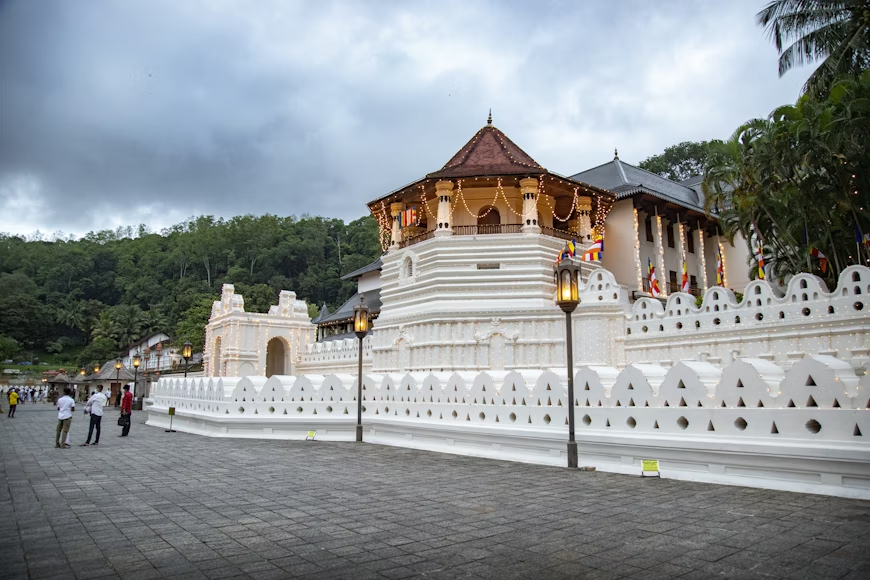
Temple of the Tooth
Sri Dalada Maligawa, known as the Temple of the Sacred Tooth Relic, is a sacred Buddhist temple, that enshrines what is believed to be left upper canine tooth of Gautama Buddha.
It stands inside the former royal palace complex of Kingdom of Kandy, and UNESCO listed the site as a World Heritage site in 1988.
The relic is regarded as a symbol of both religious and royal authority of the country, and whoever claimed the relic held the legitimacy to rule the land.
Records state that the relic reached the island in the 4th century CE when Princess Hemamala and Prince Dantha brought it from Kalinga in India during a time of conflict.
Buddhist tradition explains that the tooth was taken from the Buddha’s funeral pyre in Kushinagar and preserved in Kalinga for several centuries before its transfer to Sri Lanka.
The relic remains in the Handun Kunama, or Scented Chamber, and it is placed inside seven gold caskets shaped like stupas.
The relic is not shown to the public, and worship focuses on the outer casket presented during rituals.
Daily practices centre on Thewawa ceremonies held in the morning, at midday, and in the evening under the guidance of monks from the Malwattu and Asgiriya chapters.
The complex displays features of Kandyan architecture, including white walls, carved timber columns, and painted ceilings.
The Paththirippuwa, an octagonal structure built by the last Kandyan king, now holds a collection of old manuscripts.
The temple forms the centre of the annual Esala Perahera, and a replica of the relic casket moves through the city on a ceremonial elephant while dancers and drummers take part in the procession.

Old Royal Palace Complex
The Old Royal Palace Complex is the last royal residence and the administrative centre of the Kingdom of Kandy until it was taken over by the British in 1815.
A royal palace complex built in the 14th century under King Vickramabahu III is noted for a layout that centres on the King’s Palace, the Queen’s Palace, the Royal Audience Hall and the Queen’s Bathing Pavilion.
The site has six main entry points called Wahalkadas, identified as the Maha, Uda, Pitathi, Mohana, Madhura and Kora gateways.
The buildings later faced significant damage during Portuguese attacks in the 17th century, followed by further losses after the British takeover, with remaining sections eventually converted for public access and museum use.
Royal Botanic Gardens
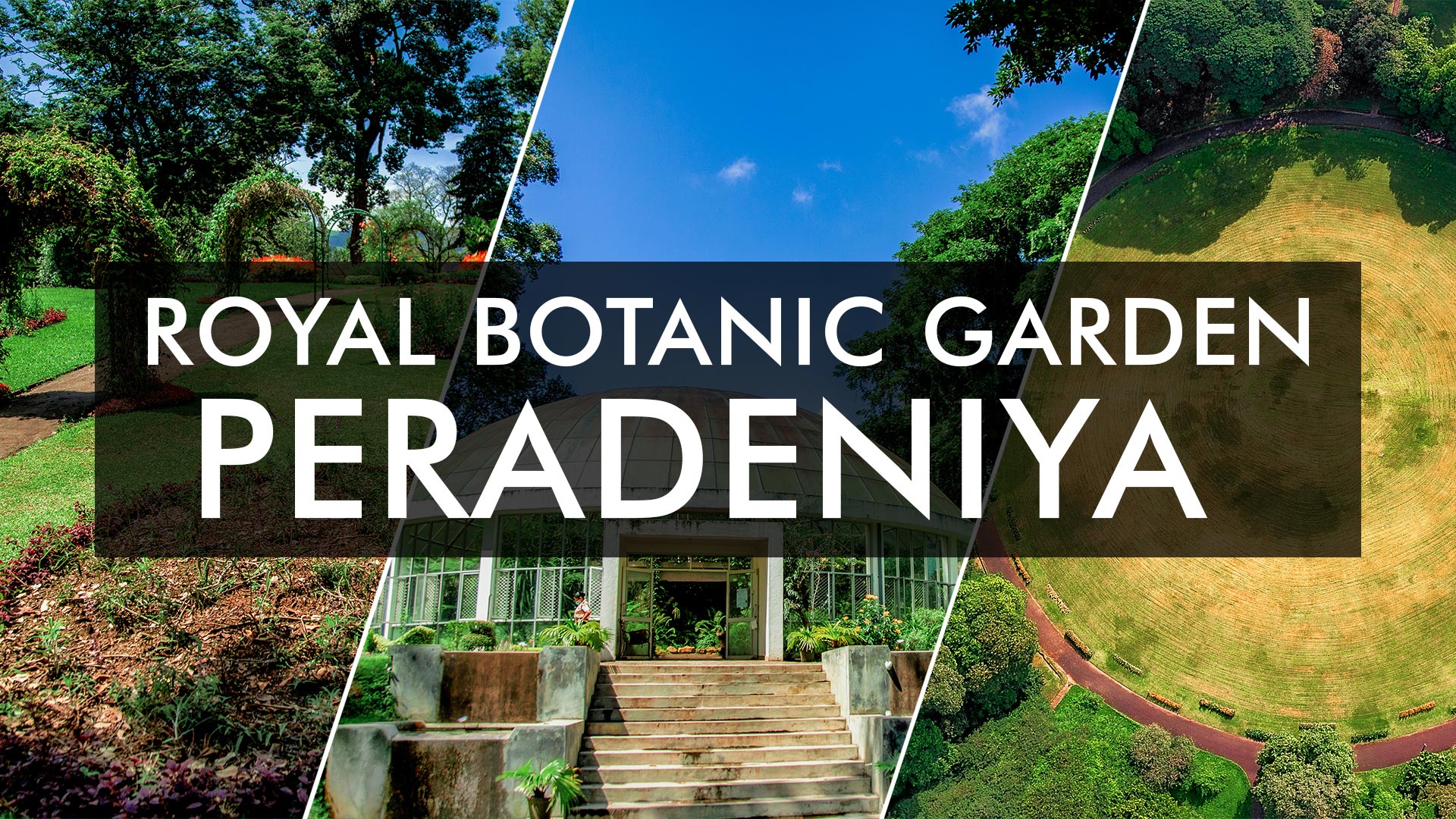
The Royal Botanic Gardens at Peradeniya, located five kilometres west of Kandy city centre, is Sri Lanka’s largest botanical garden.
The gardens cover 147 acres and were officially established in 1821 during British colonial rule, on land that previously served as a royal residence and pleasure garden for Kandyan kings.
They are internationally known for their plant collections, which include more than 4,000 species, ranging from large tropical trees to palms, spices, medicinal plants, ferns, and ornamental shrubs.
A key attraction is the Orchid House, displaying hundreds of orchid varieties from Sri Lanka and abroad. Popular walkways include the Avenue of Royal Palms, Cook’s Pine Avenue, and the Double Coconut Avenue.
Notable trees include a large Javan fig whose wide canopy covers much of the grounds, and the historic Cannonball Tree, planted in 1901 during a visit by King George V and Queen Mary.
The gardens also host the National Herbarium of Sri Lanka, which supports plant research and conservation.

Udawatta Kele Sanctuary
Udawatta Kele Sanctuary is a protected forest reserve located behind the Temple of the Sacred Tooth Relic in Kandy.
The area was once a private royal garden of the Kandyan monarchy, known as Uda Wasala Watta.
It remained restricted to the royal court during the period of the Kandyan Kingdom.
Udawatta Kele was declared a forest reserve in 1856 and later upgraded to a sanctuary in 1938.
Forest supports a layered ecosystem with more than 400 plant species, including large canopy trees, shrubs, and orchids.
The sanctuary features shaded walking trails leading to viewpoints, ancient rock hermitages, and a central royal pond.
The forest is home to around 80 bird species, including endemic birds such as the Layard’s Parakeet and the Yellow-fronted Barbet. Mammals recorded in the area include the golden palm civet, mouse deer, and the pale-fronted toque macaque.
Udawatta Kele also contains several archaeological and religious sites. These include the Senkanda Cave, remains from the British period, and three Buddhist forest monasteries.

Gadaladeniya Raja maha viharaya
Gadaladeniya Raja Maha Viharaya is a Buddhist temple near Pilimathalawa, about 13 kilometres west of Kandy, known for its strong South Indian stone architecture.
The temple was built in the 14th century during the reign of King Bhuvanekabahu IV of the Gampola Kingdom. It was designed by the South Indian architect Ganesvarachari under the guidance of the scholar monk Ven. Seelavamsa Dharmakirthi.
The main shrine is constructed mainly of stone and reflects the Vijayanagara architectural tradition. At its centre is a seated Buddha statue housed in a stone chamber with a tiered roof topped by a stupa.
A separate structure within the complex, known as the Vijayothpaya, stands nearby. It features a central stone stupa surrounded by four smaller shrines aligned to the cardinal directions.
The temple grounds also include a devale dedicated to Vishnu, who is regarded as a guardian deity of Buddhism. A Bodhi tree, a drummers’ pavilion, and a carved moonstone mark key ritual and entrance areas.
Long rock inscriptions at the site record land grants and administrative details from the medieval period. These inscriptions provide insight into religious patronage and governance during the Gampola era.

Lankatilaka Raja Maha Viharaya
Lankatilaka Raja Maha Viharaya is a historic Buddhist temple complex located on Panhalgala Rock near Pilimathalawa, about 15 kilometres west of Kandy in Sri Lanka.
The temple was built in the 14th century during the reign of King Bhuvanekabahu IV of the Gampola Kingdom and reflects a blend of South Indian and Sri Lankan architectural traditions.
Constructed in the “Gedige” style, the shrine was designed to support both Buddhist and Hindu worship, highlighting the religious coexistence of the period.
The main image house rises directly from the rock base and contains a large seated Buddha statue. Its interior is decorated with Kandyan-period frescoes and detailed plaster designs.
Historical records preserved at the site include several inscriptions that shed light on its past. The Lankatilaka Copper Plaque states that the original image house had four storeys, of which three still stand today.
Stone inscriptions written in Sinhala and Tamil record royal donations and land grants, offering valuable insight into the administration of the Gampola era.
The temple complex also includes six devales dedicated to Upulvan, Ganapathi, Sumana Saman, Vibhishana, Kataragama Deviyo, and Kumara Bandara.

Embekka Dewalaya
Embekka Devalaya is a historic temple complex near Pilimathalawa, about 14 kilometres from Kandy, best known for its detailed wooden carvings.
The shrine was built in the 14th century during the reign of King Vikramabahu III of the Gampola Kingdom and is dedicated to the Kataragama deity, worshipped by both Buddhists and Hindus.
The complex includes three main structures: the sanctum known as the Garbhaya, the Digge or dancing hall, and the Hewisi Mandapaya, used by drummers during rituals.
Each space plays a role in religious ceremonies, traditional dance, and music that continue to be practised at the site.
Embekka Devalaya has gained international attention for its craftsmanship, with UNESCO recognising it as one of the finest surviving examples of wooden architecture.
Most carvings are made from Gammalu wood and include 514 designs showing animals, mythical figures, plants, geometric forms, and scenes from daily life.
The Digge is especially notable for its 32 carved wooden pillars, which support a tiered roof designed to control rainwater.

Bahirawakanda Temple
Sri Maha Bodhi Viharaya, widely known as the Bahirawakanda Temple, is a major Buddhist site on Bahirawa Kanda hill, overlooking the city of Kandy and located about two kilometres from the city centre.
Situated at one of the highest points in Kandy, the temple is best known for its large white Buddha statue, one of the city’s most visible landmarks.
The statue, completed in 1992, depicts the Buddha in the Dhyana Mudra, or meditation posture. It stands at nearly 80 feet and dominates the skyline above the urban area.
The temple complex offers wide views across the Kandy plateau and the surrounding central highlands. From viewing areas near the statue, Kandy Lake, the Temple of the Sacred Tooth Relic, and other key landmarks are clearly visible.
The name Bahirawakanda is linked to local legend associated with a guardian spirit known as Bahirava. Folklore holds that the hill was once feared as the dwelling place of the spirit.
According to tradition, the later establishment of the Buddhist temple symbolised the transformation of the site into a place of worship, peace, and protection.
Kandy Lake
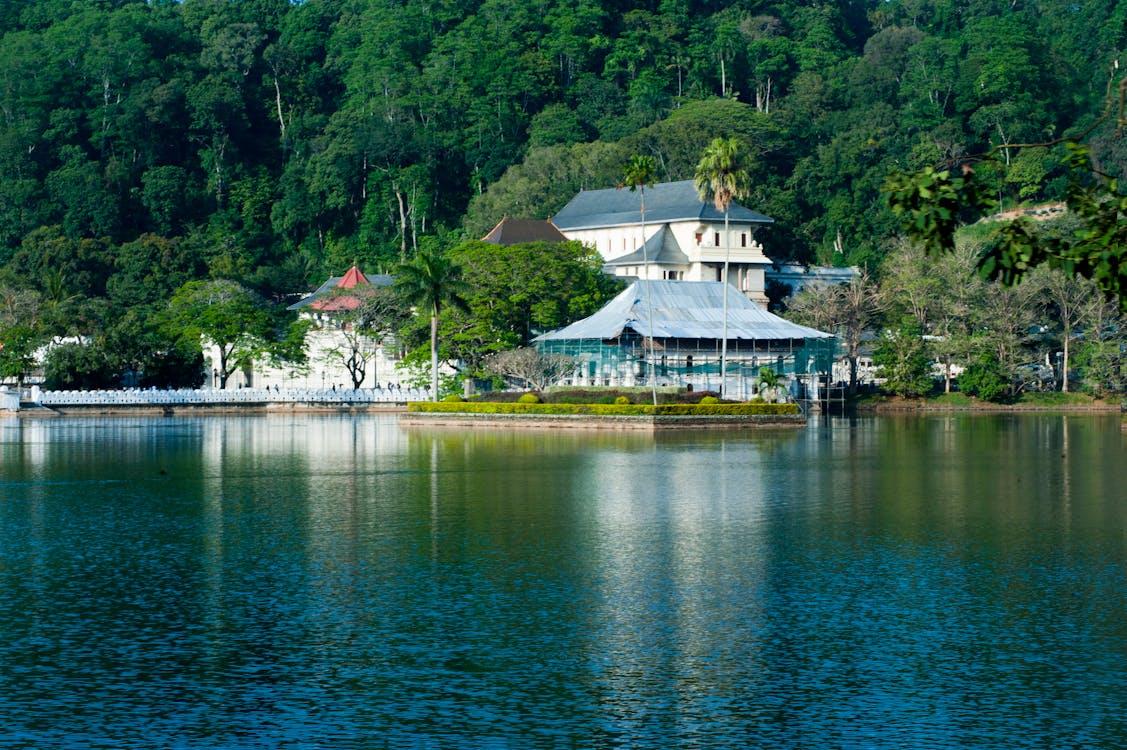
Kandy Lake is an artificial lake in the centre of Kandy, adjacent to the Temple of the Sacred Tooth Relic.
The lake was built in 1807 by King Sri Wickrama Rajasinghe on land that had previously been paddy fields.
The lake extends for about 3.4 kilometres around its perimeter and is bordered by a shaded path used by walkers and joggers. Its parapet, known as the Walakulu Bamma, is a white cloud-shaped wall that was designed to hold oil lamps during festivals.
At the centre of the lake is Diyathilaka Mandapaya, a small artificial island. It originally served as a royal summer pavilion and was later used by the British as an ammunition store.
Kandy Lake supports wildlife including birds, turtles, and monitor lizards. Boat rides provide views of nearby historic structures, including the Ulpange, or Queen’s Bathing Pavilion.